



Ontario Vehicle Innovation Network (OVIN) supports Spark’s innovative Electric Vehicle Energy Management System (EVEMS) research with a grant to help create more energy efficient buildings without costly power upgrades.
Soneil Spark’s innovative research into AI-driven power management systems has resulted in a new partnership with the Ontario government through the Ontario Vehicle Innovation Network (OVIN) and OK Tire—the largest independent tire and auto service retailer in Canada.
Through the development of proprietary AI-driven power management systems, Spark will maximize available power in commercial buildings for EV charging. The development of this innovative technology will now be accelerated thanks to an investment of more than $3.1 million, including $1 million contributed by the OVIN R&D Partnership Fund, more than $2 million invested by Soneil Spark, and $120,000 from OK Tire.

The Challenge
The growing adoption of electric vehicles has led to a rising demand for accessible charging stations (IEA). However, the lack of proper infrastructure poses a significant challenge. Many buildings struggle to install charging stations due to limited power capacity and grid strain (McKinsey), with power system upgrades being both costly and time-consuming. To meet the rising demand for EV charging, the options are either to increase power capacity or to use existing power more efficiently.
Most power grids are currently unable to support the anticipated rise in electricity consumption driven by EVs and broader electrification. In Ontario, for example, around 134 TWh of power is currently available. The Independent Electricity System Operator (IESO) projects that demand will grow by 2% annually, reaching 154 TWh in 2025 and 245 TWh by 2050. This growth is primarily fueled by economic and population
expansion, as well as the electrification of industries such as mining, steel, and electric vehicles. By 2050, the government plans to add another 5,000 MW of capacity, but this will not be enough to meet the projected demand.
A solution is required to overcome power shortages and enable the widespread installation of charging stations without the high costs and complexities typically involved.
Why buildings are currently energy inefficient
Buildings normally have unused power due to predefined circuit allocation, which results in energy inefficiency and waste. In many buildings, power is allocated based on estimated load requirements, which may not match actual usage. For example, a typical retail building in Ontario might have a rated power capacity of 200A, but only 80% (160A) can be utilized due to a 20% buffer required by code.
And it gets worse. Of the 160A available, the building must consistently reserve approximately 120A to accommodate occasional peaks. In many buildings, this “Reserved Power” remains unused. As a result, without the use of an Electric Vehicle Energy Management System (EVEMS), only the “Dynamic Surplus”—approximately 40A (160A minus 120A)—would be available for other uses, such as powering EV chargers.
Avoiding expensive electrical upgrades
The requirement to reserve 120A for potential peaks leaves a significant portion of the power unutilized during off-peak periods, resulting in inefficiencies and missed opportunities for energy optimization.
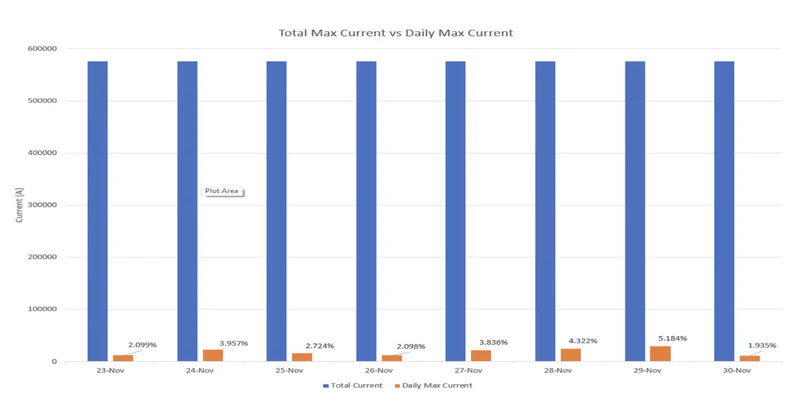
The following illustrates the actual power usage in an Ontario building (orange) and the total power available throughout the day (blue). A significant portion of the available power in the building is
held in reserve and never used.
Spark’s innovative EVEMS
The current EVEMS products on the market are unable to fully utilize all the unused power in a building. At present, these systems can only access 10-20% of the available Reserved Power during off-peak times.
This lack of effective power management products underscores the need for innovative solutions capable of dynamically optimizing and reallocating power usage in real-time to alleviate grid strains (IEA, Energy Conservation).
Spark’s proprietary solution
Spark’s innovative solution addresses this by utilizing all the unused power (Dynamic Surplus and Reserved Power) available in a building and redirecting it in real time. This dramatically increases a building’s available power without the considerable time and costs associated
with expensive power upgrades, which can range from $100,000 to $200,000 depending on the property. Best of all, Spark’s EVEMS is compatible with all building types and 90 percent of electrical systems.

Unlike buildings with no EVEMS (Reserved Power is unavailable) or buildings using current EVEMS (which can only access 10-20% of the Reserved Power at off-peak times), Spark’s intelligent system can utilize all available unused power thanks to our proprietary AI and Machine Learning technology.
By intelligently managing and reallocating energy, Spark’s system helps buildings use power more efficiently while supporting EV charging and broader sustainability goals.
Spark’s easily integrated system dramatically increases available power, accessing up to 70 percent more reserved power compared to existing systems while managing EV charging, and can also incorporate renewable energy sources like solar and wind.
Spark’s innovative EVEMS utilizes power more efficiently, learning and optimizing electrical performance in real time from
the moment it’s installed.